


Last Updated: November 7, 2026
Quick Summary
Yes, you can add cooling to existing ducted heating in many homes using add-on refrigerated cooling, which shares the ducts and vents your gas heater already uses. Compatibility depends on your heater, ductwork and roof space, so an inspection is needed before quoting.
- Add-on cooling uses the same ducts and vents as your gas heater, so no second network is needed.
- Cool air is denser than warm air, so ducts sized only for heating may be undersized for cooling.
- Insulated ducts are essential for cooling to prevent condensation and lost cooling capacity.
- Add-on cooling has the lowest upfront cost when the heater and ducts are sound.
- Reverse-cycle is the better spend when the heater is old or the ducts are poor.
Table of Contents
- Can You Add Cooling to Existing Ducted Heating?
- Add-On Cooling for Ducted Gas Heating: What It Involves
- Ducted Heating System Compatibility: A Practical Checklist
- Add-On Air Conditioning Cost: What Drives the Quote
- Add-On Cooling vs Reverse-Cycle Air Conditioning
- Installation, Performance Limits and Climate Suitability
- Getting a Free Quote for Your Home
- Frequently Asked Questions
Can You Add Cooling to Existing Ducted Heating?
Yes, you can add cooling to existing ducted heating in many homes. The most common approach is add-on refrigerated cooling, which shares the ducts and vents your gas heater already uses.
Here is the short version.
But first, here is what most guides get wrong. They say “yes” or “no” without checking the parts that actually decide it.
Below, we walk through how add-on cooling works, how to check your system, what drives the cost, and when reverse-cycle air conditioning is the better call.
How add-on refrigerated cooling works with your heater
Add-on refrigerated cooling is a cooling unit that connects to the ductwork your gas heater already uses.
The two systems run separately. Your gas heater warms the air in winter. The add-on cooling unit cools it in summer.
If you want to see the technology up close, our ducted refrigerated air conditioning page explains how refrigerated cooling works as a standalone system too.
The main appeal is simple: you keep the heating you already paid for and add cooling without a second network of ducts.
Add-On Cooling for Ducted Gas Heating: What It Involves
An add-on cooling setup for ducted gas heating involves three main parts working together: a refrigeration unit, an indoor coil, and the shared duct system. Each one has to suit the other two.
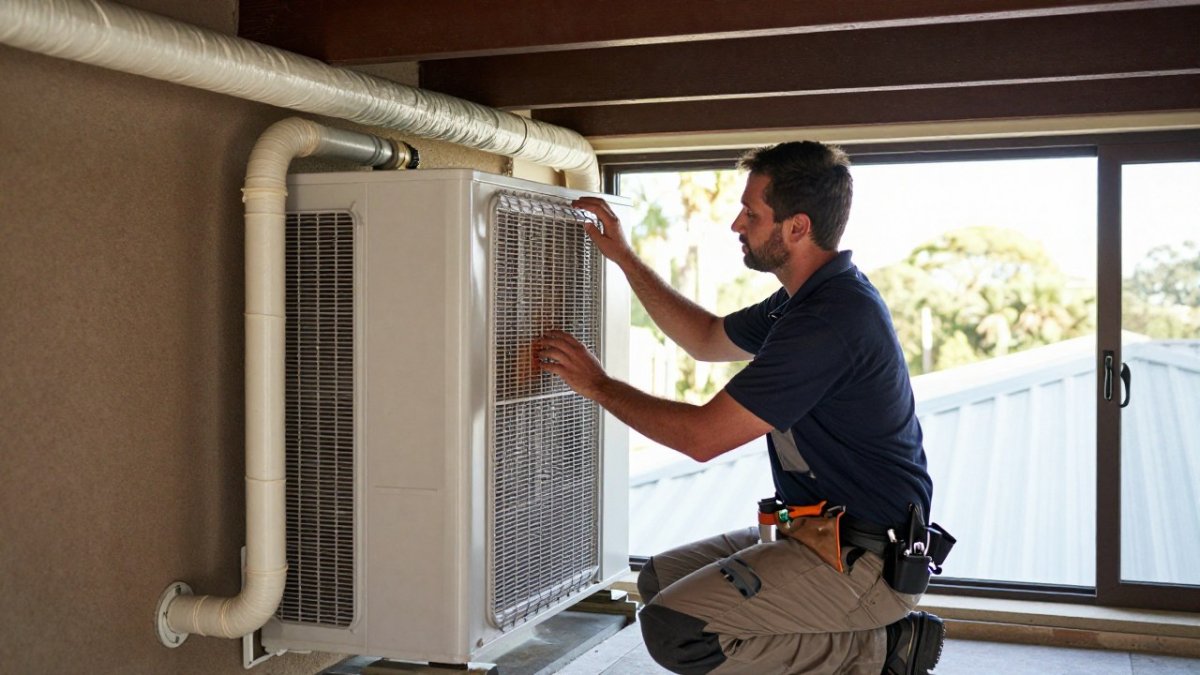
The refrigeration unit, indoor coil and shared ducts
The refrigeration unit sits outside and does the cooling.
The indoor coil goes into the air stream, usually near or inside the heater cabinet.
The shared ducts carry that cooled air to every room, using the same vents as your heating.
The catch is airflow. A duct system built only for heating may not move enough air for cooling.
That is why we check the ducts before we quote, not after.
Ducted Heating System Compatibility: A Practical Checklist
Ducted heating system compatibility comes down to your heater, your ductwork, and your vents. Most guides stop at a tick-box list. This one explains what each check actually means, how to assess it yourself, and when a failure rules add-on cooling out rather than just adding cost.
Checking your heater, ductwork and vents before you commit
Work through these in order. The first two can rule the job out on their own; the rest mostly affect cost and performance.
- Heater type and model: Add-on refrigerated cooling is designed to pair with ducted gas heaters that have a compatible indoor coil or coil cabinet. Some gas ducted heaters can take an add-on coil, but the coil must match the heater’s airflow and cabinet dimensions. Check the heater’s model and serial plate, then confirm with the manufacturer or a licensed technician that an add-on coil is listed for that model. If the heater is a non-ducted or obsolete model, add-on cooling is usually not an option.
- Heater age and condition: Heaters that are old or have a heat exchanger showing corrosion or cracking are often a poor base for a new cooling unit. The cooling coil sits in the same air stream, so a failing heater contaminates the cooling side and may need replacing soon after. If the heater is near end of life, put the money toward a reverse-cycle system instead.
- Duct size and airflow: Cooling needs more airflow than heating because cool air is denser. Ducts that were sized only for heating may be undersized for the cooling unit’s rated airflow. Ask the installer to compare the proposed cooling unit’s airflow (litres per second) against the existing duct capacity. If the ducts cannot move the required air, some rooms will be weak regardless of unit size.
- Duct insulation: Insulated ducts are essential for cooling. Uninsulated or poorly insulated ducts cause condensation on the duct surface in humid weather and lose cooling capacity before the air reaches the room. If your ducts are uninsulated, budget for an insulation upgrade as part of the job.
- Duct condition and leakage: Look for tears, crushed sections, disconnected joints, and sagging runs. Leaking ducts waste both heating and cooling and can pull hot roof-space air into the system. A pressure test or visual inspection by the installer will show whether the ductwork needs repair or replacement before cooling is added.
- Vent count and placement: Cooling needs enough outlets, in the right rooms, for even distribution. If some rooms have no vent or the vents are poorly placed, add-on cooling will not fix that without ductwork changes. Count the outlets and compare them with the rooms you actually want cooled.
If several boxes are unticked, add-on cooling may cost more than it is worth.
Watch out: a heater that passes a visual check can still fail on airflow or coil compatibility.
Our guide to ducted cooling system design for homes goes deeper into sizing and layout if you want to judge your own ducts.
Add-On Air Conditioning Cost: What Drives the Quote
Add-on air conditioning cost depends on more than the cooling unit itself. The unit is one line. The rest is the work around it. Most quotes you receive will be built from the same components, so understanding them lets you compare quotes fairly and spot where a cheap price is hiding extra work.
Here is what moves the number up or down:
- Cooling capacity: Bigger homes and more zones need a larger unit, which costs more both to buy and to run. Capacity is matched to the home’s heat load, not just floor area.
- Ductwork changes: New ducts, extra vents, or re-routing add labour and parts. If the existing ducts are undersized or poorly laid out, this can be a significant line item.
- Duct insulation: Upgrading uninsulated ducts is often needed for cooling and is priced per metre plus labour.
- Electrical work: A dedicated circuit may be required, and switchboard upgrades add cost.
- Roof access and height: Tight or steep roofs take longer, and some jobs need extra access equipment.
- Old unit removal: Disposal and make-good add to the job.
Pricing depends on the home, so the only reliable figure is a quote based on an inspection.
How add-on cooling compares with the alternatives
The more useful question is not what add-on cooling costs on its own, but how it compares with the other ways to cool the same home. A side-by-side view over time usually looks like this:
- Add-on cooling: Lowest upfront cost when the heater and ducts are sound, because you reuse the existing duct network and heating system. Running costs are limited to summer cooling plus the gas you already use in winter.
- Split systems: Lower upfront cost for one or two rooms, but you need a unit per zone and you do not get whole-home cooling through existing vents. Running costs depend on how many units run at once.
- Replacing with reverse-cycle ducted: Highest upfront cost, but it replaces both heating and cooling with one system and can be more efficient over time, especially if the old gas heater was inefficient. It is the better financial call when the heater is near end of life, because you avoid paying twice.
The total-cost comparison is where add-on cooling wins or loses. If the heater is failing, the add-on cost is money spent on a system you will soon replace.
If you are also weighing a full system change, our cost of replacing ducted heating guide helps you compare the two paths side by side.
Add-On Cooling vs Reverse-Cycle Air Conditioning
Add-on cooling vs reverse-cycle air conditioning is the decision most homeowners face. Both cool your home.
| Feature | Add-On Cooling | Reverse-Cycle Air Conditioning |
|---|---|---|
| Uses existing ducts | Yes | Only if ducted |
| Keeps gas heating | Yes | No, replaces it |
| Heating in winter | From gas heater | Built in |
| Best for | Good heater, sound ducts | Old or failing systems |
| Disruption | Lower | Higher |
Add-on cooling wins when your gas heater is healthy and your ducts are up to the job.
Reverse-cycle wins when the heater is old, the ducts are poor, or you want one system for everything.
If your heater is over its useful life, a system that handles both heating and cooling is generally the better spend.
Installation, Performance Limits and Climate Suitability
Installation timing depends on the job. The team fits the outdoor unit, the indoor coil, connects the ducts, and tests airflow room by room.
Expect some disruption: access to the roof space, power isolation, and a bit of noise while the outdoor unit goes in. We plan the day so you know when power is off and when we finish.
Performance has limits worth knowing:
- Cooling is only as even as your ducts allow. Poor ducts mean uneven rooms.
- Very hot days test any system. Good insulation and shading still matter.
- Add-on cooling suits mild to warm climates well. In extreme heat, a properly sized reverse-cycle system may hold up better.
Getting a Free Quote for Your Home
The fastest way to know if add-on cooling suits your home is a proper check.
Before you hire anyone, read our guide on how to compare HVAC installation quotes so you know what a fair quote should include.
Adding cooling to existing ducted heating can be simple, or it can open a can of worms. The difference is whether your heater and ducts are ready for it.
Frequently Asked Questions
Can you use existing vents and ductwork for heating and cooling?
In many homes, yes. Add-on refrigerated cooling can share the same ducts and vents as your ducted heating, provided the ductwork is the right size, well sealed and in good condition. A technician will check airflow, duct size and insulation before confirming suitability. If the ducts are undersized or leaking, they may need upgrading before cooling is added, which affects the overall quote.
Is add-on cooling compatible with every ducted heating system?
No. Compatibility depends on your heater’s model, age and type. Most gas ducted heaters can accept an add-on cooling coil, but some older or compact systems have limited space or airflow capacity. A ducted heating system compatibility check by an experienced technician is the only reliable way to confirm whether your existing heater can support add-on cooling without compromising performance.
How much does it cost to add cooling to ducted heating?
Add-on air conditioning cost varies with system size, ductwork condition, electrical requirements and whether upgrades are needed. Pricing depends on your home’s layout, the number of zones and the cooling capacity required, so a site assessment gives the most accurate figure. Ask for a written quote that itemises the unit, installation and any duct or electrical work.
Is add-on cooling better than installing a separate air conditioner?
It depends on your home. Add-on cooling uses one set of ducts and vents, so it can be less disruptive and more economical to run than separate systems in some homes. Reverse-cycle air conditioning offers independent heating and cooling and can replace ageing gas heating. Comparing add-on cooling vs reverse-cycle air conditioning with a technician helps you choose based on your layout, budget and long-term running costs.
When is it better to replace ducted heating with a reverse-cycle system?
If your ducted heater is old, inefficient or nearing the end of its life, replacing it with a reverse-cycle ducted system can make more sense than adding cooling to failing equipment. A reverse-cycle system handles both heating and cooling in one unit and may suit homes moving away from gas. An independent assessment of system age, condition and running costs will show which option delivers better value.