


Table of Contents
- Why Professional HVAC System Removal Matters
- The Professional HVAC Decommissioning Process Explained
- Refrigerant Gas Recovery Regulations You Need to Know
- VEU Scheme Gas Heater Rebate: What You Can Claim
- What Removal and Disposal Services Include
- Factors That Influence Removal and Disposal Costs
- Repair or Remove? A Cost-Benefit Framework
- Frequently Asked Questions
Last Updated: September 16, 2026
Why Professional HVAC System Removal Matters
Removing an old air conditioner is not a matter of unbolting a box from a wall. Every HVAC system removal and disposal service exists because refrigerant circuits, mains wiring and roof penetrations make this a licensed trade job, not a weekend project. At Premium Air, we have managed thousands of installations across Victoria, and the old unit coming out is where most of the risk sits.
Here is what makes professional removal genuinely necessary:
- Refrigerant is a controlled substance. The gas inside your system must be recovered, not vented, and only a licensed technician can do it legally.
- Electrical disconnection is regulated work. Hardwired outdoor units and ducted systems connect to circuits that require a licensed electrician.
- The unit is heavy and awkward. A ducted system’s indoor unit and condenser unit are bulky, and roof or ceiling access makes DIY removal genuinely dangerous.
- Disposal has a paper trail. Scrap metal, e-waste and refrigerant each go through different channels.
The Australian Refrigeration Council’s licensing guidance sets out who is permitted to handle refrigerant, and it is not the homeowner.
The most common mistake we see is a homeowner disconnecting an old split system themselves and venting the refrigerant to make the unit lighter. That is an offence under environmental law, and the fine lands on the person who did it, not the installer.
The Professional HVAC Decommissioning Process Explained
Professional HVAC decommissioning is the staged shutdown of a system before physical removal: refrigerant recovery, electrical isolation, mechanical disconnection, then disposal. Skipping any stage creates a legal or safety problem downstream, and the liability for that problem usually lands on the homeowner, not the operator.
A standard decommissioning sequence looks like this:
- Site assessment. The technician confirms the system type, refrigerant charge and access route.
- Gas evacuation. A recovery machine pulls refrigerant into a cylinder for reuse or destruction. This is the step that must be performed by a holder of the relevant ARC licence, venting refrigerant to atmosphere is an offence under national environment law, and the penalty applies to the person who authorised or performed the venting.
- Electrical disconnection. A licensed electrician isolates and caps the circuit at the switchboard. Hardwired outdoor units and ducted systems cannot be safely isolated by a general handyman.
- Mechanical removal. Copper pipe removal, bracket removal and lifting of the condenser unit. The condenser and compressor are heavy and awkward; roof or ceiling access adds fall risk.
- Hazardous component separation. Capacitors, printed circuit boards, insulation and any oil residue are separated for e-waste or hazardous-waste processing rather than general landfill. Capacitors can retain a charge even after isolation, and PCBs contain materials that must not leach into soil.
- Site cleanup and make-good. Sealing wall and ceiling penetrations, patching mounting holes, and removing all components from site.
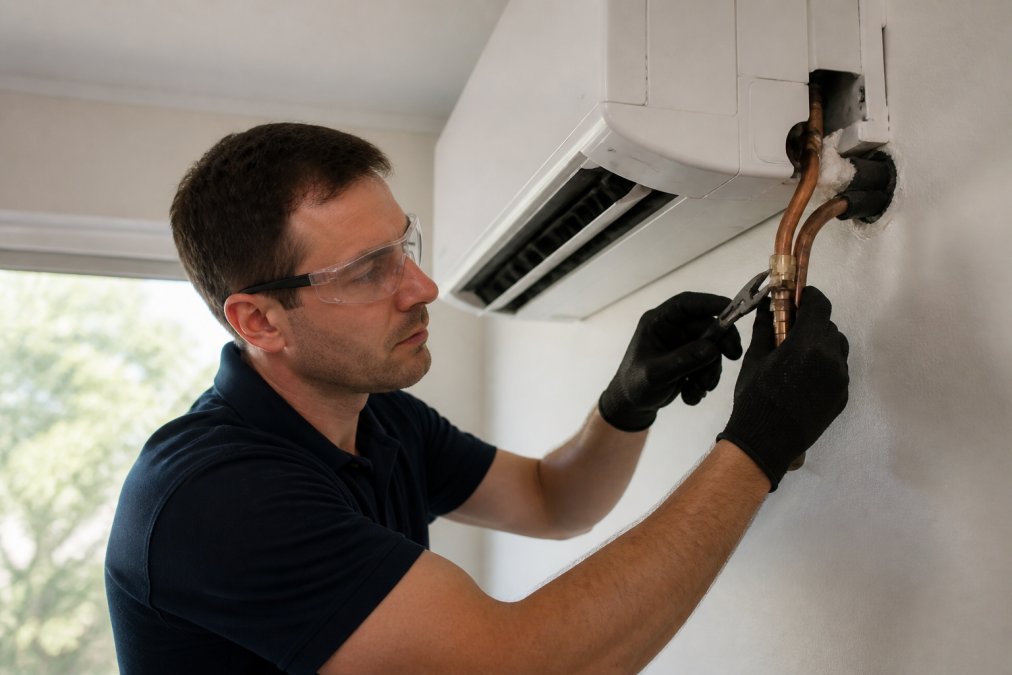
What most guides miss is that steps five and six are where cheap operators cut corners. A system can be removed in an hour and leave a hole in your wall for six months, or leave capacitors and circuit boards in the general waste stream. A complete decommissioning job accounts for every component, not just the visible metal.
The legal liability point is the one homeowners most often overlook. If you engage an unlicensed person to remove your system and they vent the refrigerant, the offence is committed by the person who did it, but the paper trail and the environmental harm trace back to your property. Always confirm the technician’s ARC licence before work begins.
Refrigerant Gas Recovery Regulations You Need to Know
Refrigerant gas recovery regulations require that ozone-depleting substances and synthetic greenhouse gases be recovered by a licensed technician and never released to the atmosphere. In practice, this means the person removing your system must hold the right licence and carry recovery equipment.
The rules cover more than the headline gas. Older systems may contain R22, a hydrochlorofluorocarbon being phased out, while newer units run on blends with high global warming potential. Both must be captured.
This is also where the compliance paperwork matters. A legitimate operator can tell you where the recovered gas went and provide documentation if asked.
Ask for the technician’s ARC licence number before booking. A licensed operator will give it without hesitation. If the answer is vague, that is your answer.
For the regulatory detail behind refrigerant handling, the Department of Climate Change, Energy, the Environment and Water guidance on refrigerant management is the reference point worth reading.
VEU Scheme Gas Heater Rebate: What You Can Claim
Removing a gas ducted heater, or any gas heating appliance, can attract a government rebate under the Victorian Energy Upgrades scheme, commonly called VEU. The scheme is administered at state level and rewards households for replacing inefficient gas heating with efficient electric alternatives.
The practical points to understand:
- The rebate is tied to the replacement, not the removal alone.
- Eligibility depends on the appliance being decommissioned and the new system meeting scheme requirements.
- The value of the incentive changes over time, so current figures should always be confirmed against the official scheme.
Because the rules and incentive values are updated periodically, we recommend checking the Victorian Energy Upgrades program information directly for the current position before you plan a replacement.
What Removal and Disposal Services Include
Here is what a full service should cover:
| Component | What Happens to It | Why It Matters |
|---|---|---|
| Refrigerant | Recovered into cylinders by a licensed technician | Venting is illegal |
| Copper pipework | Removed and sent for scrap metal recycling | Recovers value, avoids landfill |
| Condenser and compressor unit | Lifted out and processed as scrap | Heavy, awkward, unsafe to move alone |
| Indoor unit and evaporator coil | Removed and separated by material | Mixed materials need sorting |
| Electrical components and circuit boards | Routed to e-waste recycling | Contains hazardous materials |
| Wall and ceiling penetrations | Sealed and made good | Prevents moisture and pest entry |
Factors That Influence Removal and Disposal Costs
- System type. A wall-mounted split system is a straightforward job: one indoor head, one outdoor condenser, short pipe run. A ducted air conditioning system with roof-mounted plant takes longer because the indoor unit and ductwork must be accessed through the roof cavity, and the condenser may need a crane or extra labour to lift out.
- Access. Second-storey outdoor units, tight side passages and roof cavities all add time. A condenser mounted on a bracket three metres up a wall needs safe access equipment; a unit on a ground-level slab does not.
- Refrigerant charge. Larger systems hold more gas, which takes longer to recover. The recovery process itself is not complex, but the volume of refrigerant determines how many cylinders and how much time the technician needs.
- Disposal fees. Scrap metal recycling is often cost-neutral or better because copper and steel have recovery value. Hazardous waste disposal and e-waste carry handling costs because capacitors, circuit boards and insulation must be processed separately from general waste.
- Make-good work. Patching a wall is quick; repairing a ceiling or re-roofing a penetration is not. An open penetration lets water and vermin into a ceiling cavity, so this is not cosmetic.
Repair or Remove? A Cost-Benefit Framework
Use this framework:
- Is the unit more than 10-15 years old? Older systems use phased-out refrigerants and parts become scarce.
- Has it needed two or more repairs in two years? Repeat faults usually signal end of life.
- Is it a gas ducted heater? Replacing it may unlock a VEU incentive, which shifts the maths.
- Is the running cost climbing? An inefficient system can cost more over a few years than a replacement.
- Are you renovating or renting the property out? A newer system reduces maintenance headaches for tenants.
Before committing to removal, ask a technician to quote both a repair and a replacement. A unit that seems dead may only need a capacitor or a service, and that changes the cost-benefit calculation entirely.
Repair or Remove? A Cost-Benefit Framework
Use this framework:
- Is the unit more than 10-15 years old? Older systems use phased-out refrigerants and parts become scarce.
- Has it needed two or more repairs in two years? Repeat faults usually signal end of life.
- Is it a gas ducted heater? Replacing it may unlock a VEU incentive, which shifts the maths.
- Is the running cost climbing? An inefficient system can cost more over a few years than a replacement.
- Are you renovating or renting the property out? A newer system reduces maintenance headaches for tenants.
Frequently Asked Questions
How much does it cost to remove an air conditioning unit?
Pricing for HVAC system removal depends on the unit type, accessibility, and whether refrigerant recovery is required. Factors like roof access, asbestos presence, and wall repair needs also affect the final price. Premium Air includes old unit removal as part of installation, so request a free quote for an accurate figure based on your specific setup.
What happens to the refrigerant gas during HVAC removal?
Refrigerant gas must be recovered by an ARC-licensed technician using specialised equipment before any disconnection occurs. This prevents ozone-depleting substances from escaping into the atmosphere, which is a legal requirement under Australian refrigerant gas recovery regulations. The recovered gas is then transported to a licensed facility for safe processing or destruction. Never allow anyone without proper certification to handle refrigerant during removal.
Are there government rebates for removing old gas heating appliances?
Yes. Removing a gas ducted heater or any gas heating appliance can attract a government rebate under the Victorian Energy Upgrade (VEU) scheme. The rebate amount depends on the appliance type and the replacement system installed. To claim, the work must be completed by an accredited provider who can issue Victorian Energy Efficiency Certificates. Ask your installer whether your removal qualifies before booking.
How do I ensure my old HVAC system is disposed of sustainably?
Choose a removal service that follows proper environmental compliance procedures. Sustainable disposal includes refrigerant gas recovery, scrap metal recycling for condenser units and copper pipes, and hazardous waste disposal through licensed facilities. Ask your provider where the unit ends up and whether they issue documentation. Premium Air handles complete site cleanup and responsible disposal as part of the removal service.