


Table of Contents
- What You’ll Need Before Starting
- Understanding SEER and SEER2 Ratings
- SEER vs EER Ratings Explained
- Reading Energy Rating Labels on Split Systems
- Step-by-Step: Calculating Cooling Output and Power Consumption
- Real-World Efficiency vs. Laboratory Test Values
- How to Improve Air Conditioner Efficiency
- Common Mistakes to Avoid When Calculating Efficiency
- Frequently Asked Questions
Last Updated: September 20, 2026
Understanding how to calculate HVAC system efficiency is essential when choosing a new heating or cooling system for your home. Most people struggle with the terminology and calculations involved. This guide breaks down the key metrics, shows you step-by-step how to calculate efficiency, and explains what those numbers mean for your energy bills.
What You’ll Need Before Starting
Gather the cooling capacity in BTU/h (British thermal units per hour), power consumption in watts, and your local electricity rate from your energy bill. Have a calculator handy for accurate comparisons.
Don’t confuse cooling output (heat removed) with power consumption (electricity used). A system with high cooling output but low power consumption is efficient.
Check your electricity bill for the per-kilowatt-hour rate. This number varies by provider and time of use, so using your actual rate gives you accurate cost projections rather than estimates.
Understanding SEER and SEER2 Ratings
SEER stands for Seasonal Energy Efficiency Ratio. It measures how much cooling a system produces per unit of electricity consumed over an entire cooling season. The higher the SEER rating, the more efficient the system. SEER ratings typically range from 10 to 26, with higher numbers indicating better efficiency.
SEER is calculated by dividing total cooling output (in BTU) by total energy input (in watt-hours) over a full cooling season, with seasonal weighting applied to account for varying outdoor temperatures.
The shift from SEER to SEER2
Australia is transitioning to SEER2, a newer standard with updated test procedures that includes testing at higher outdoor temperatures and lower indoor cooling loads, more accurately reflecting real-world operation.
SEER2 ratings are typically 15-20% lower than equivalent SEER ratings because testing is more rigorous, not because the system is less efficient. When comparing old and new systems, use the actual cooling output and power consumption figures instead of comparing ratings directly.
SEER2 is the current standard for new systems. If you’re comparing an old system rated only in SEER to a new one in SEER2, use the underlying BTU/h and wattage figures to make a fair comparison.
SEER vs EER Ratings Explained
EER (Energy Efficiency Ratio) measures efficiency at a fixed 35°C outdoor temperature, showing how your system performs on peak summer days.
EER is calculated like SEER but at a single temperature point rather than seasonal average. A system with high SEER but lower EER performs well overall but less efficiently during temperature spikes.
For Australian conditions, EER is particularly relevant because summer temperatures regularly exceed 35°C. Pay attention to both SEER (overall seasonal performance) and EER (peak-load performance).
| Metric | What It Measures | When It Matters | Typical Range |
|---|---|---|---|
| SEER | Average efficiency across full cooling season | Comparing total seasonal energy use | 10-26 |
| SEER2 | Average efficiency with updated test procedures | New systems and current standards | 8-20 |
| EER | Efficiency at fixed 35°C outdoor temperature | Peak summer cooling performance | 3-7 |
Reading Energy Rating Labels on Split Systems
Energy rating labels display a star rating (1-10 stars), SEER or SEER2 rating, EER rating, cooling capacity in kilowatts, and power consumption in watts.
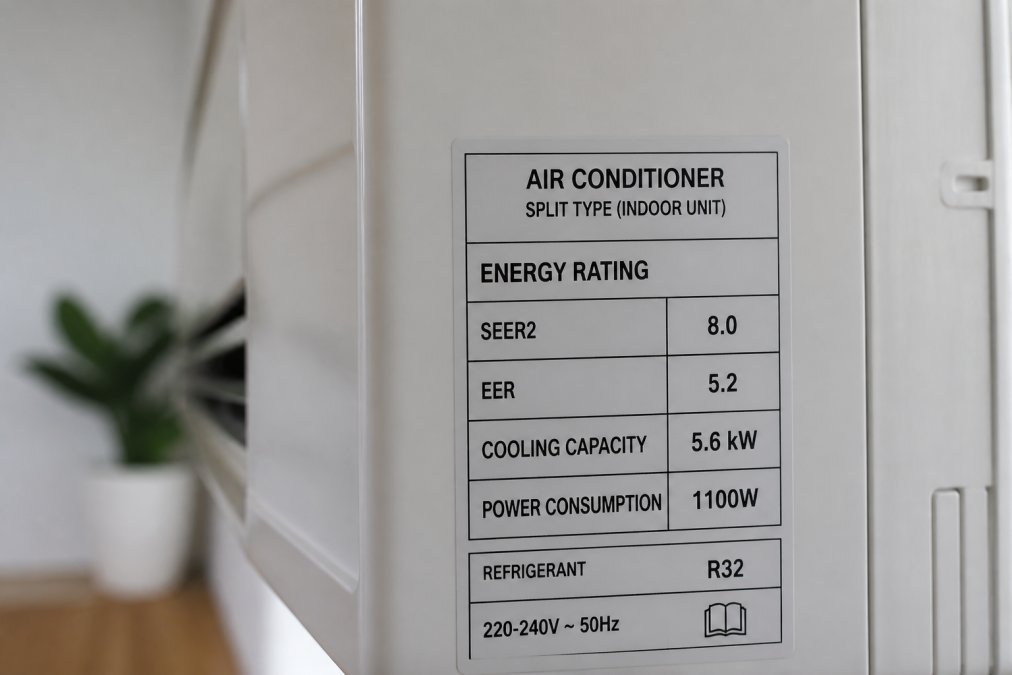
The star rating is a simplified guide for consumers. A 10-star system is highly efficient and will cost less to run than a 5-star system. However, the actual SEER or SEER2 number gives you more precision. A 7-star system might have a SEER2 of 8.5, while another 7-star system has a SEER2 of 9.2. The numerical rating lets you compare systems more accurately.
The cooling capacity (in kilowatts) tells you how much heat the system can remove per hour under test conditions. A 5.6 kW system removes more heat than a 3.5 kW system, but it also uses more electricity. Matching capacity to your home’s needs is crucial, oversizing wastes energy and money, while undersizing leaves you uncomfortable on hot days.
Never assume a higher star rating means lower running costs. A 10-star 3.5 kW system might cost more to run than a 7-star 5.6 kW system if you need the extra capacity. Always compare actual SEER2 ratings and cooling capacity together.
Step-by-Step: Calculating Cooling Output and Power Consumption
To understand how to calculate HVAC system efficiency, start with the raw numbers: cooling capacity in BTU/h and power consumption in watts. Let’s work through a practical example.
Suppose you’re looking at a split system with these specifications:
- Cooling capacity: 12,000 BTU/h
- Power consumption: 1,200 watts
First, convert BTU/h to a consistent unit. One BTU equals approximately 1,055 joules. So 12,000 BTU/h equals about 12,660,000 joules per hour, or 3,517 watt-hours per hour (divide joules by 3,600 seconds).
Alternatively, use this simpler conversion: divide BTU/h by 3.412 to get the equivalent in watts of cooling output. So 12,000 BTU/h ÷ 3.412 = approximately 3,517 watts of cooling output.
Now you can calculate the coefficient of performance (COP), which is the cooling output divided by the power input:
- COP = 3,517 watts cooling ÷ 1,200 watts power = 2.93
A COP of 2.93 means the system produces 2.93 units of cooling for every 1 unit of electricity consumed. The higher the COP, the more efficient the system.
Converting BTU/h to kilowatt-hours
To estimate how much cooling a system delivers over time, convert the capacity to kilowatt-hours. If your system runs continuously for one hour at full capacity, it delivers 3.517 kilowatt-hours of cooling (using the 3,517 watts figure from above).
In reality, systems don’t run continuously at full capacity. They cycle on and off to maintain your set temperature. On a mild day, the system might run 30% of the time. On a hot day, it might run 80% of the time. Manufacturers account for this variation through seasonal weighting when calculating SEER and SEER2.
Working out annual energy costs from wattage
To estimate your annual cooling costs, multiply the power consumption by the hours the system runs per year, then multiply by your electricity rate.
Here’s a practical example:
- Power consumption: 1,200 watts (1.2 kilowatts)
- Estimated annual cooling hours: 1,500 hours (typical for Melbourne)
- Electricity rate: $0.30 per kilowatt-hour
Annual energy cost = 1.2 kW × 1,500 hours × $0.30 = $540 per year
This is an estimate because it assumes the system runs at full power for 1,500 hours. In reality, the system cycles on and off, and its actual power consumption varies with outdoor temperature and your indoor set point. However, this calculation gives you a ballpark figure for comparing systems.
A more efficient system (higher SEER2 or lower wattage) will have a lower annual cost. If a comparable system uses 900 watts instead of 1,200 watts, the annual cost drops to $405, a saving of $135 per year or $1,350 over a decade.
Use these annual cost estimates to compare systems side by side. A system that costs $200 more upfront but saves $150 per year in energy costs pays for itself in less than 18 months.
Real-World Efficiency vs. Laboratory Test Values
Laboratory tests measure efficiency under controlled conditions: fixed outdoor temperature, fixed indoor humidity, and steady-state operation. Real-world conditions are messier. Your outdoor temperature fluctuates. Your home has thermal losses through walls and windows. The system cycles on and off rather than running continuously.
In practice, real-world efficiency is often 10-20% lower than laboratory ratings. A system rated SEER2 9.0 might deliver closer to SEER2 7.5-8.0 in your home. This isn’t a flaw in the system, it’s a reflection of how buildings and weather actually work.
Several factors affect real-world performance. Poor insulation in your walls increases cooling demand and reduces efficiency. Blocked air vents restrict airflow and force the system to work harder. Incorrect refrigerant charge reduces cooling capacity and efficiency. Undersized ductwork increases pressure drop and energy consumption.
This is where professional installation and design matter.
How to Improve Air Conditioner Efficiency
Several practical steps improve how efficiently your air conditioner runs. Start with maintenance: clean or replace filters every three months, keep outdoor condenser coils free of debris, and have the system serviced annually by a qualified technician. A dirty filter forces the system to work harder and wastes energy.
Common Mistakes to Avoid When Calculating Efficiency
One frequent error is confusing cooling capacity with efficiency. A 7 kW system is not necessarily more or less efficient than a 5 kW system, capacity and efficiency are separate properties. A small, highly efficient system and a large, less efficient system can have very different annual energy costs.
Frequently Asked Questions
What is the difference between SEER and EER ratings?
SEER (Seasonal Energy Efficiency Ratio) measures cooling efficiency across an entire season under varying temperatures, while EER (Energy Efficiency Ratio) measures efficiency at a single outdoor temperature of 35°C. SEER2 is the newer standard that uses more realistic test conditions. EER is useful for understanding peak-load performance, whereas SEER gives a better picture of year-round running costs. Both appear on Australian energy rating labels.
How do I read an Australian energy rating label for air conditioning?
Australian energy labels display the SEER2 rating (or SEER for older units), EER value, and cooling capacity in kilowatts. The label shows a star rating from 1 to 6 stars, with more stars indicating better efficiency. Look for the cooling output (BTU/h or kW), power consumption in watts, and the estimated annual energy cost.
Why does my system’s real-world efficiency differ from the test rating?
Laboratory ratings assume ideal conditions: steady outdoor temperatures, proper airflow, and clean filters. In reality, your home’s layout, insulation, outdoor temperature swings, maintenance, and how often you use the system all affect actual efficiency. A system rated SEER2 8.0 might deliver lower efficiency if your home has poor insulation, blocked vents, or a dirty filter. Regular maintenance and proper system sizing (neither oversized nor undersized) help you achieve closer to rated performance.
Can I calculate my system’s efficiency using my electricity bill?
Yes, you can estimate efficiency by dividing total cooling output (in joules or kilowatt-hours) by the energy consumed (from your bill). However, this method has limitations: your bill includes heating, hot water, and other appliances, making isolation difficult. A more accurate approach is to track usage over a full cooling season and compare actual kilowatt-hours consumed to the system’s rated capacity and SEER2 value.